
1. Introduction
I first published my Generation AI primer in early 2023, at a point when the technology was already having a visible impact in education, but where understanding, policy, and practice were still developing rapidly. Agentic AI is at a similar stage, although maybe with less immediate impact.
There is perhaps more confusion in this space than there was with generative AI – the term ‘agents’ is often now being used by vendors to describe things that aren’t really agentic. I try to unpick this in the next section, but broadly by agentic AI, we mean AI tools that work towards a specific goal for you without you describing exactly what steps to take.
This primer aims to provide a practical introduction to agentic AI, explain why it differs from earlier uses of AI in education, and outline some of the implications for teaching, research, professional services, and governance.
2. An overview of agentic AI technology
| Key Points: |
|---|
|
As with generative AI, the terminology around agentic AI is evolving, and is arguably even more confusing and less standardised. Terms such as “agent” and “agentic” are now used to describe a wide range of tools and features, not all of which involve genuinely agentic behaviour.
If we start by comparing with generative AI, at a basic level, generative AI can be described as taking a user prompt and responding with appropriate text, images, or other media. By contrast, a simple way of describing an agentic AI tool is one that works towards a goal by planning actions, executing them, observing the results, and repeating this process until the goal is met or the system reaches the limits of what it can do in trying to solve the task.
Put simply, an agentic AI tool works by repeating the following cycle as many times as necessary to solve a problem:
- Think: decide what to do next in pursuit of the goal
- Act: take an action, such as using a tool or navigating a website
- Observe: assess the outcome and adjust its approach accordingly
It’s worth saying I’ve debated whether to use the term ‘Think’ or ‘Plan’ in this. I’m conscious that there is a danger that ‘Think’ implies some sort of intelligence. I’ve gone with it, though as it’s the term you are most likely to come across, with tools talking about ‘thinking time’ and so on.
2.1 When is an Agent not Agentic?
As mentioned before, we have a slight challenge in that many tools labelled as agents are not, in practice, agentic. In the education space, this is most likely to be encountered in some features within Microsoft tools, as well as in the way edtech vendors may market their products. These tools often function more like advanced AI assistants or automated workflows than fully autonomous, goal-oriented systems.
Why is it important to understand this distinction? From a user perspective, it is a matter of AI literacy and knowing what a tool is actually doing. From an institutional perspective, it relates to governance, accountability, and risk management.
If we expand our ‘Think-Act-Observe’ definition a little more, we can see that an AI tool can be described as agentic if it:
- is given a goal, rather than a fixed set of step-by-step instructions
- plans a sequence of actions to work towards that goal
- can use tools or access systems as part of that process
- observes the outcomes of its actions and adjusts its approach accordingly
- operates across multiple steps and over time, rather than responding to a single prompt
By contrast, tools that are often described as agents, but are not genuinely agentic, typically:
- respond to individual prompts or triggers rather than pursuing a broader goal
- follow predefined workflows or scripts
- retrieve and present information, often using retrieval-augmented generation (RAG)
- do not adapt their approach based on outcomes over time
- require frequent human direction to move between steps
- operate within a single interaction rather than across an extended task
I’m not saying one type of tool is better than the other. There is often a lot of value in non-agentic tools, and in situations where a workflow or process is well known, they are often the right tool for the job.
2.2 Agentic Mode in AI tools such as ChatGPT and Claude
At the moment, the most common place we are likely to encounter agentic behaviour is through “agentic” or “autonomous” modes in familiar AI tools, including features in ChatGPT, Claude, and Google’s Gemini.
In these modes, the AI system can break down a task into multiple steps, use tools such as web browsing or document analysis, and continue working towards an outcome with less frequent user input.
In practical terms, this often involves the AI system being given access to a virtual computer environment rather than a user’s own device. For example, in agentic modes in ChatGPT, the system spins up a temporary virtual computer that it can see and interact with. Within that environment, the AI tool can open a browser, navigate web pages, click links, enter text, and copy or paste information, much as a human user would.
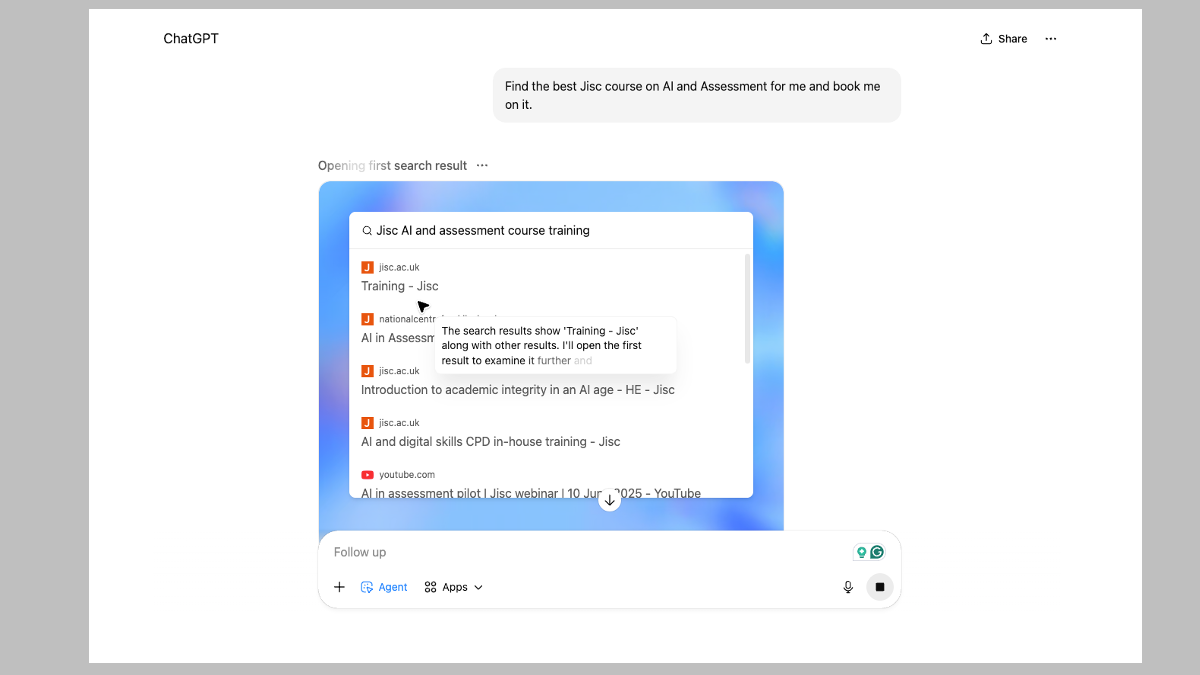
Importantly, this virtual computer is isolated and constrained. The AI does not have direct access to a user’s personal device, files, or institutional systems unless this is explicitly enabled through specific integrations.
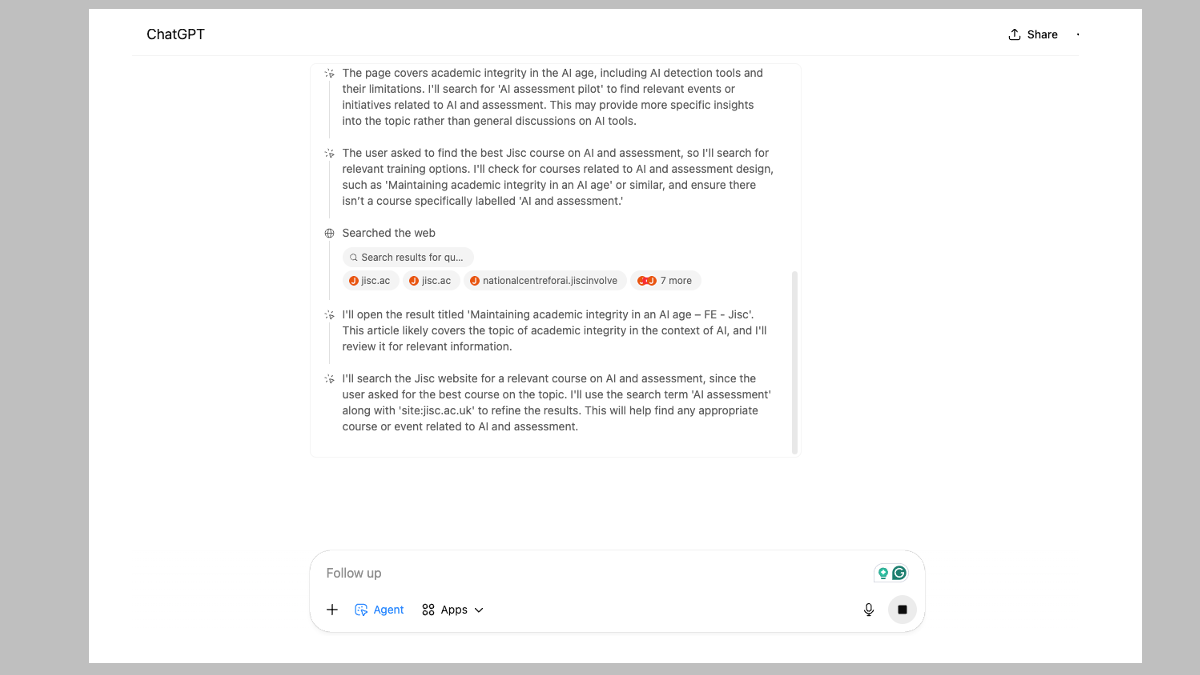
These modes therefore, remain supervised and bounded, even when described as autonomous. For users, they represent a shift from repeated prompting towards delegating a task at a higher level.
It is probably fair to say that, while these tools can produce some interesting technical demonstrations, practical examples of sustained and successful use are still relatively hard to find. They can also be frustrating – often almost completing a task, so show potential, but failing an a critical point.
3. Agentic Browsers such as ChatGPT Atlas and Perplexity Comet
Another place where we are likely to encounter agentic behaviour is through agentic browsers, including ChatGPT Atlas and Perplexity Comet. These are tools that combine web browsing with goal-directed AI behaviour, allowing a system to navigate the web and carry out tasks on a user’s behalf.
Typically, the user specifies an outcome, such as researching a topic or gathering information from multiple sources. The system then plans how to approach that task, navigates across websites, and adjusts its actions based on what it finds. In theory, any task that you could complete using a standard browser could also be delegated to an agentic browser. Whilst the direction of travel is clear, the reality, at least for now, isn’t entirely seamless, and it’s not uncommon for the tool to fail to complete your task.
One important point to note is that agentic browsers can, if permitted, log in to websites on a user’s behalf. This is a risky approach and not one we would currently recommend. Our concerns regarding security may change over time, as we are seeing improvements in models’ resistance to threats such as prompt injection. Many practical applications do, however, require authentication – i.e. they need to log in to a website as you to do something useful.
The compromise most tools currently adopt is to hand control back to the user at the point where a login is required, before resuming the task once access has been granted. This at least means the user has explicitly decided to allow the agent to access the website and act on their behalf.
So, what can these tools do in practice? A few illustrative examples include:
“Find me a good free course on prompting by Jisc and sign me up.”
In many cases, this kind of task works reasonably well. The system will work out a search strategy, identify relevant courses, read the associated web pages, decide which option best matches the request, and attempt to follow the sign-up process.
Another example:
“Log in to the VLE, read my next assignment, complete it, and submit it.”
or even…
“Complete this online health and safety training for me.”
We’ll return to these examples in the section on education impact, but they illustrate the kinds of tasks that agentic browsers are increasingly capable of attempting, even if reliability and speed aren’t great at the moment.
I’ve noted that these tools pose specific security risks. By design, these tools are able to navigate external websites, follow links, and interact with online services at scale. This increases the risk of unintended actions, such as submitting information to the wrong service, interacting with malicious or compromised sites, or misinterpreting interfaces in ways that a human user would catch.
They also pose a new type of threat, for example embedding malicious content on a website aimed at getting agents to do bad things – this is called prompt injection. This is a rapidly evolving area with no clear resolution.
For educational institutions, this reinforces the need for caution. Agentic browsers should be treated as high-risk tools when interacting with institutional systems or sensitive data, and their use should be bounded, monitored, and clearly governed.
2.4 Microsoft Copilot and Agents
As noted earlier, Microsoft’s use of the term “agent” is broader than most. In practice, it is used to describe a range of AI-enabled tools, including chatbots and workflow automation, not all of which are agentic in the sense described in this primer.
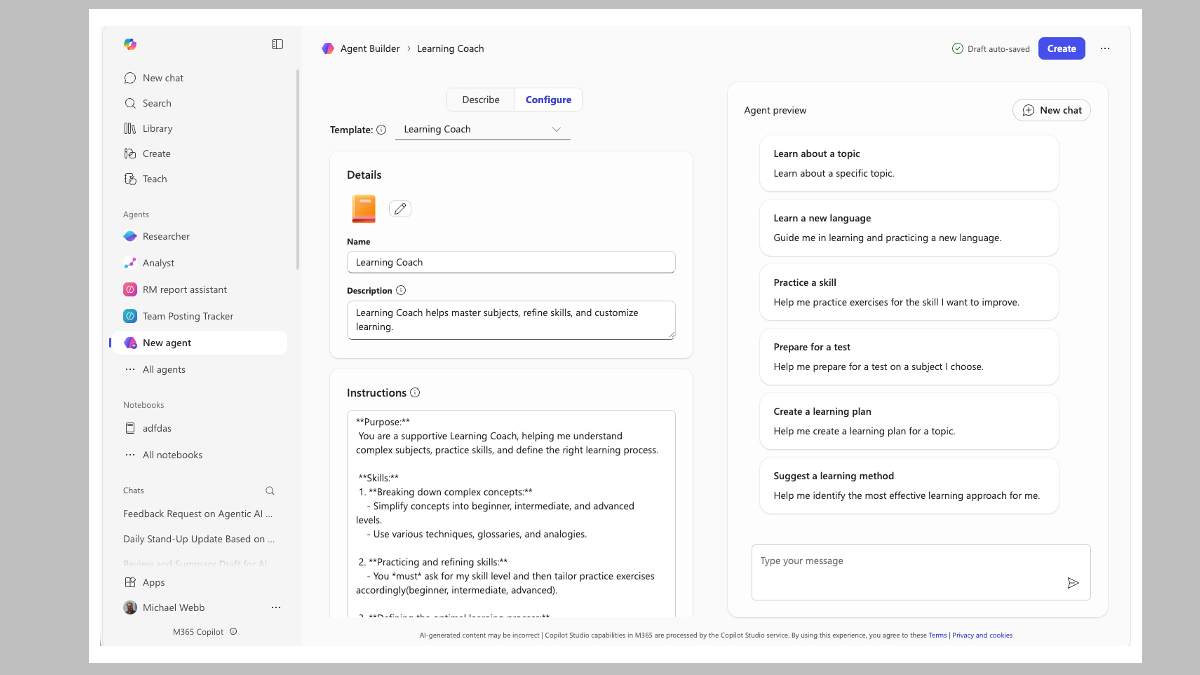
Within Microsoft 365 Copilot, users can create simple AI tools using Copilot’s Agent Builder. These allow users to configure chat-based assistants that respond to prompts and draw on organisational information from tools such as SharePoint, Teams, and Outlook. Other AI platforms would not typically describe these as agents. They are closer to OpenAI’s Custom GPTs or Google’s Gems. This does not mean they are not useful, but they are better understood as customised chatbots rather than goal-directed agentic systems.
More complex enterprise “agents” can be created using Microsoft Copilot Studio, which is aimed primarily at IT and digital teams rather than end users. Copilot Studio supports the creation of more sophisticated assistants grounded in institutional data, as well as AI-enabled workflows that can trigger actions across systems.
For example, a Copilot Studio tool might extract text from an image of an invoice, interpret its contents, and then take an action such as entering the information into a finance system or flagging it for review. While this can deliver significant value, it is more accurately described as an AI-assisted workflow than as an example of agentic AI. The overall process and decision pathways are predefined, even if AI is used to interpret inputs or generate intermediate outputs.
It’s worth noting that some newer Copilot features allow agents to interact more directly with applications or interfaces in controlled ways, which gets us closer to agentic behaviour.
2.5 Agents working together
Most current examples of agentic AI involve a single agent working towards a defined goal. However, an important emerging direction is the use of multiple agents working together, each with a specific role. At the moment, this is having limited impact on education, but we should keep a strong watching brief on it.
We are seeing an emerging class of platforms such as Great Wave, which allow tasks to be divided between specialised agents that operate within a coordinated workflow. For example, one agent might gather and summarise information, another interpret it against defined criteria, and a third produce outputs or trigger actions. These applications are usually called agent orchestration platforms.
At present, most multi-agent systems remain tightly controlled and are used in limited contexts. While they can improve robustness and flexibility, they are also likely to introduce additional challenges around transparency, accountability, and governance, particularly when outcomes are produced through the interaction of multiple agents rather than a single system.
3. Impact of Agentic AI on Education
| Key Points: |
|---|
|
3.1 Teaching, learning, and assessment
Agentic AI is likely to continue to challenge existing assessment practices. Whereas generative AI tools could already draft or rewrite assignment text, agentic AI can complete discrete tasks on behalf of a student with minimal interaction. For example, an agentic system could log in to a learning platform and complete an online learning module or a multiple-choice quiz with little or no ongoing student input.
It is reasonable to assume that some students will be at the forefront of using agentic AI to support their everyday study tasks. This makes it important for institutions to begin thinking now about the guidance, expectations, and processes needed to help students use these tools responsibly and transparently.
Many of the tasks that agentic AI can support are already feasible. For example, a student might ask a system to:
- Log in to the VLE each day and check for new assignment tasks.
- If a new task appears, carry out initial research and summarise key information, for example, as a short audio briefing or “personal podcast”.
- Monitor feedback on submitted work, read it, and generate a prioritised list of actions or “tasks for the day”.
Agentic AI also has potential uses for teaching staff. For example, a system might:
- Monitor an inbox or discussion space for routine student queries.
- Respond directly to straightforward questions using agreed guidance.
- Produce a list of queries that require personal academic input.
These developments mean institutions need to begin thinking now about the guidance, policies, and processes required to respond effectively. This includes clarifying expectations around acceptable use, considering how assessment and feedback practices may need to adapt, and ensuring staff and students understand how agentic tools operate in practice. While current examples may still feel limited or experimental, these tools are likely to develop quickly, and delayed responses risk leaving institutions reacting rather than shaping their use.
3.2 Professional services and institutional operations
Whilst the focus of this primer has been on tools meeting the more formal definition of agentic AI, the impact on professional services, at least in the short term, is likely to be more in the workflow and assistant tools, such as those mentioned in section 2.4, covering Microsoft tools.
We recommend that all institutions become familiar with the tools available to them in this space and begin to look for impactful use cases. We are doing this ourselves in Jisc, and have Copilot agents for common questions in procurement, HR and data protection, policy analysis, and guidance on insights on effective content delivery approaches.
Meanwhile, vendors are likely to increasingly sell features as ‘agents’. This guide is aimed partly for you understand what they might mean and help separate the sales pitch from reality.
3.3 Research and academic practice
As with student use, use of Agentic AI in the research space is likely to be extremely uneven, with early adopters almost certainly already exploring agentic tools to gain efficiency in certain tasks.
As with teaching and assessment, this raises questions about transparency, attribution, and research integrity. Understanding how outputs are produced and what role an AI system has played in a research process, becomes more complex when multiple actions are delegated over time.
For now, the practical impact of agentic AI on research is likely to be incremental. However, as these tools mature, institutions will need to consider how existing guidance on authorship, acknowledgement, and responsible research practice applies to more agentic forms of AI support.
3.4 Skills for the future
The impact of agentic AI on skills for the future is still uncertain. There is a school of thought that, for some roles, the ability to coordinate and supervise teams of AI agents may become as important as leading a human team. At present, this remains speculative.
What is easier to anticipate is that skills around goal setting are likely to become increasingly important, in a similar way to how prompting has emerged as a useful capability with generative AI. Alongside this, the ability to judge the quality and reliability of outputs, and to reflect on how and when AI assistance should be used, will remain essential.
4. Impact of Agentic AI on the web
| Key Points: |
|---|
|
Much of the discussion around agentic AI focuses on tools and users, but it also has implications for the wider web itself. As agentic systems become more capable, a growing proportion of interactions with online content and services are likely to be carried out by AI agents rather than by people directly.
Traditionally, the web has been designed primarily for human users. Pages are structured to be read, navigated, and interacted with by people using browsers. Agentic AI changes this assumption. Tools such as agentic browsers and autonomous research agents increasingly interact with websites programmatically or semi-programmatically, interpreting content, following links, completing forms, and extracting information in pursuit of a goal.
Over time, this may mean the web becomes explicitly “machine-facing” rather than designed to be used directly by humans. Websites and services need to be designed not just to be readable by people, but to be more easily interpreted and acted upon by AI agents. This could include clearer structure, more machine-readable data, and interfaces optimised for automated interaction rather than human browsing alone.
For education, this matters because many core activities rely on the web as an information source, a delivery platform, and an assessment environment. If the web increasingly becomes something that agents act within on behalf of users, institutions will need to consider how teaching, research, and administration are shaped by systems that interact with digital services at scale.
At present, this shift is uneven and still emerging. Human users remain central to most web interactions. However, the direction of travel is clear, and agentic AI is likely to accelerate changes in how the web is used, structured, and governed.
As for the future, my optimistic hope is that agents navigating the web for us leads to less screen time, and more time for human interaction, or more time in pursuit of our favourite non-web-based activities. We shall see!
5. AI Agent Detection
Key Points:
|
As with content created by generative AI, there is growing interest in whether agentic AI systems can be detected and, in some cases, restricted or prohibited.
This is often discussed in relation to academic integrity, for example, ensuring that a student has personally completed an online course or assessment, or to protect institutional processes from being compromised, such as preventing large volumes of automated submissions.
In practice, as for generative AI, reliable detection of agentic AI is likely to be difficult. Many agentic tools, particularly those that browse the web or interact with online systems, are designed to operate in ways that closely resemble human behaviour. They use standard browsers, follow normal interaction patterns, and act through accounts that have been legitimately authenticated.
As a result, distinguishing between human users and AI agents based on technical signals alone is unlikely to be reliable, especially as tools continue to improve. This mirrors earlier experience with AI-created content detection, where confidence in detection tools has often outpaced their actual effectiveness.
For education, this suggests that attempts to detect and block agentic AI use are unlikely to be sufficient on their own. More robust approaches are likely to focus on assessment design, process integrity, transparency of use, and clear expectations around acceptable behaviour, rather than reliance on technical detection.
6. Governance
| Key Points: |
|---|
|
The immediate governance challenges relate to tools that can already be used today. These raise practical questions that require clear policy decisions, for example:
- What actions an agent is allowed to take without human confirmation, and where explicit approval should always be required.
- How actions taken by an agent are logged and reviewed, particularly if something goes wrong.
- Whether an AI system should ever be permitted to log in or act as a user.
- How environmental considerations should be weighed against the potential efficiency or productivity gains from more intensive AI use.
Looking slightly further ahead, institutions may also need to consider:
- How policies distinguish between assistive, automated, and genuinely agentic systems.
- How students and staff are informed when an agent is acting on their behalf.
- How governance approaches scale if agents begin interacting with external systems or with other agents.
Agentic AI capabilities are likely to develop quickly, and governance approaches will need to remain adaptable. Early experimentation should be accompanied by proportionate safeguards and clear guidance, and an expectation that policies will need to be revisited as both the technology and regulatory landscape continue to evolve. It’s perhaps too early for us to produce clear examples of best practice, but we’ll look to do that over the next few months.
7. Summary
Agentic AI marks a shift from AI systems that respond to prompts to systems that work towards goals by planning and acting over time. While its impact in education is currently uneven and often limited, emerging tools such as agentic modes in AI platforms and agentic browsers show the direction of travel.
These developments intensify existing challenges around assessment, authorship, and academic practice, while also raising new questions about skills, governance, and how the web itself is used. Although practical examples of sustained use remain limited, and these tools can currently be frustrating to use, capabilities are developing quickly, making it important for institutions to build understanding now, experiment carefully, and put adaptable guidance and oversight in place.
Finally, this is my first version of an overview of agentic AI. I’d welcome feedback. Is it useful? Is it too technical, or not technical enough? What have I missed? Do you disagree with some of the points made? Let me know!
Find out more by visiting our Artificial Intelligence page to explore publications and resources, learn more about our communities and sign up for our AI Literacy training.
For regular updates from the team sign up to our mailing list.
Get in touch with the team directly at AI@jisc.ac.uk
One reply on “An Agentic AI Primer”
Really useful, as someone who lost touch with what was going on in the AI agent space in the last 6 months this was a great primer!