At Jisc, we’re committed to supporting colleges and universities as they shape their approach to the opportunities and challenges of AI. To do this well, it’s important that we also look inward, testing ideas, building understanding, and learning from our own experiences. Earlier this year, we began running AI Impact Workshops with colleagues across the organisation. The aim was to step back, look at how we work, and ask where AI might play a constructive role.
This blog gives an overview of the process we followed, why we chose this approach, how the workshops were run, and what happened next. In future blogs, we’ll dig into what we learned and the lessons that can be shared.
Why we took this approach
AI is often discussed in broad, sweeping terms. But the most useful insights usually come from the ground up. Rather than starting with tools or technologies, we focused on three questions:
- Where does the time go in our daily work?
- Why do those tasks take as long as they do?
- Where might colleagues feel comfortable introducing AI support?
This people-first approach helped us frame AI not as a solution in search of a problem, but as a set of tools that might help address real needs.
How we ran the workshops
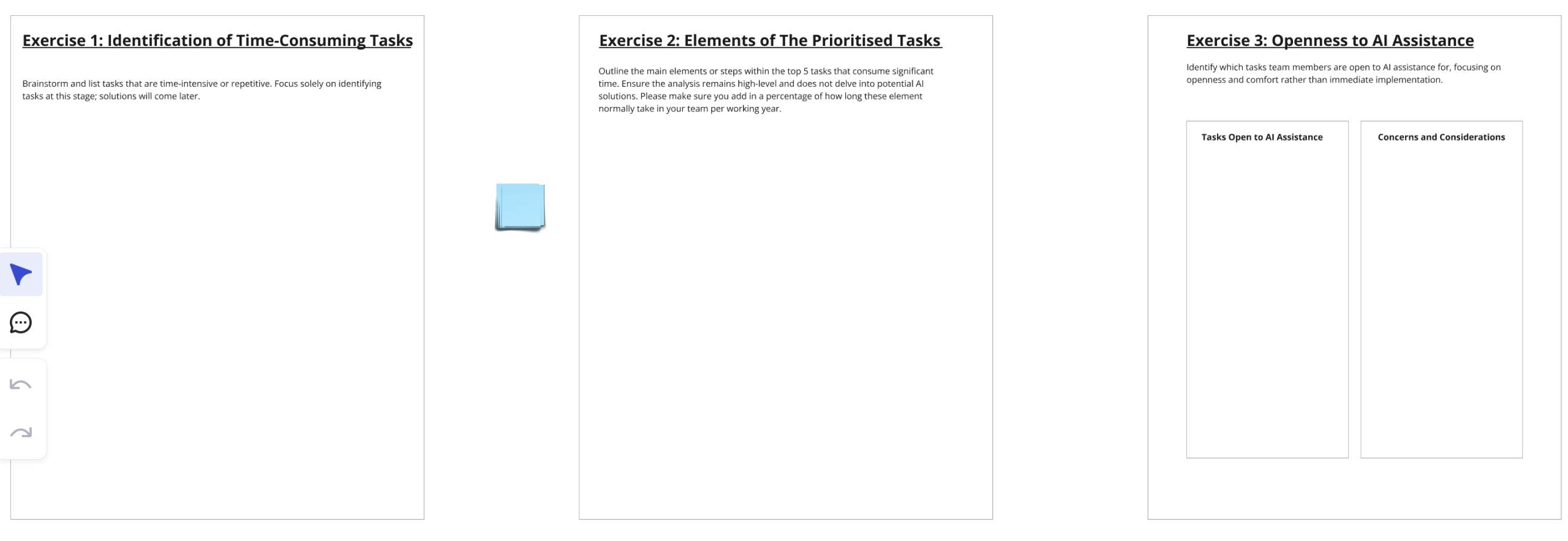
We designed a 90-minute interactive session, bringing colleagues together to reflect on their work and capture insights in a structured way. Miro boards provided the framework. Using digital sticky notes and templates, participants could quickly add ideas, cluster them into themes, and make connections visible. The session was divided into three activities:
- Identifying time-consuming tasks: surfacing activities that routinely take up the most effort.
- Breaking down why these tasks take time: Mapping the steps and spotting bottlenecks. We also asked participants to estimate the time spent on each area identified. This provided a clearer picture of potential efficiency gains and informed the return-on-investment (ROI) calculations for any future recommendations.
- Exploring openness to AI: discussing where AI might help, and where it should play little or no role.
This format proved effective: in just an hour and a half, we created a collective picture of where effort is concentrated, what slows it down, and where there might be openness to new approaches. Below is a screenshot of the template of the Miro board we used for the workshops.
Post workshop actions
What happened after the workshop is just as important as the session itself. We were clear with participants from the start that the outputs would feed into a wider process, with recommendations formally written up and shared back with the teams who took part. Depending on the findings, these reports could include:
- Defined AI opportunities: Highlighting specific tasks that AI could reasonably support. This might involve piloting a tool in a specific workflow, purchasing licences for enterprise platforms such as Microsoft 365 Copilot or Teams Premium, or offering additional training to help colleagues make better use of existing tools.
- Assessment of feasibility and ROI: We compiled findings into a report that evaluated viability, considering technology requirements, return on investment, data availability, and potential efficiency gains.
- Pilot recommendations: Small scale trials in selected areas, with outcomes reported back to participants so teams can see the tangible impact of their contributions.
This ensures the workshops don’t stop at ideas: they produce evidence-based recommendations that can directly inform team-level decisions.
What’s next
This blog has given an overview of the process: why we ran the workshops, how they were structured, and what happened after them. In the next blog, we’ll dive deeper into how we worked out the return on investment for the tasks identified, and explore the key themes, boundaries, and opportunities that came to light. Our aim is to make this journey transparent so that others in the sector can see not just the outcomes, but the steps we’ve taken along the way.
Find out more by visiting our Artificial Intelligence page to explore publications and resources, learn more about our communities and sign up for our AI Literacy training.
For regular updates from the team sign up to our mailing list.
Get in touch with the team directly at AI@jisc.ac.uk