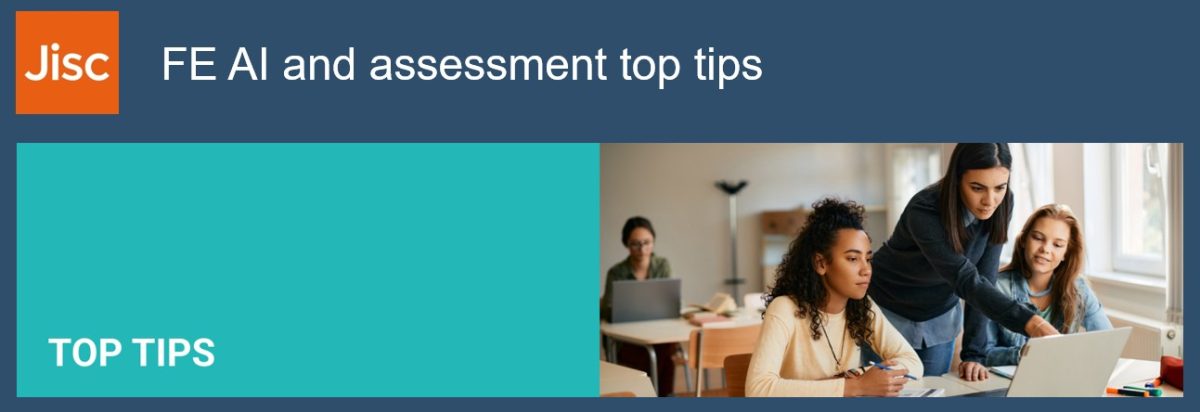
At the end of last year, we brought together a working group to explore how artificial intelligence (AI) is influencing assessment in further education (FE). When we first met, we didn’t have a fixed outcome in mind. What we did know was that AI was raising new questions about fairness, academic integrity, and the kinds of skills learners need.
As the conversations developed, one idea gained traction: putting together a set of practical, adaptable top tips that could help staff make confident decisions around assessment and AI use.
The working group brought together a range of perspectives, from assessment design, to developing learners’ AI literacy, to supporting wellbeing. The aim wasn’t to set rules, but to offer useful guidance.
The group met between December and May, a span that gave us time to reflect on assessment from multiple angles. It allowed us to think about assessment at different points in the academic year, and to base the tips on what staff are really seeing and experiencing.
Shaping the top tips
Our initial idea was to structure the tips around three stages: before, during, and after assessment. But as discussions evolved, we found a simpler approach worked best: before and after assessment.
Before assessment: This section focuses on design and preparation. It includes tips on:
- Setting clear expectations around how AI can and can’t be used.
- Designing assessments that offer variety and encourage higher-order thinking.
- Creating opportunities for learners to practise and reflect on AI use in a safe, formative way. For example: “Learners using AI may need to be aware of how to track and log their usage to comply with guidelines e.g., recording prompts, outputs and which tools were used. Confirm they are confident doing this and run a short activity to demonstrate.”
After assessment: This part supports staff during marking and feedback. It includes tips on:
- Approaching potential AI misuse with care and empathy.
- Using multiple methods to check understanding where needed. For example: “If you believe a learner has used AI inappropriately in their work, use multiple methods to verify your concerns. For example, combine written responses with oral explanations, practical demonstrations, or follow-up discussions to confirm understanding.”
- Reflecting on what worked well and what could be improved next time.
The top tips also link to useful resources, we encourage colleges to tailor these to suit their own approaches, policies and learner needs.
How to access the FE AI assessment top tips?
The FE AI Assessment Top Tips are now available to view and download. To download, just click the three-dot menu (…) on the post and select Download attachment.
Thank you to everyone who contributed their time, insight and experience to this working group.
Contributors
- Adam Leeson – SMB College Group
- Diane Weatherup – South Eastern Regional College
- Helen Nicholson-Benn – Jisc
- Ingrid Abraham – Coulsdon Sixth Form College
- James Parker – USP College
- Kim Blanchard – Activate Learning
- Kingsley Saba – Sense College Loughborough
- Nigel Holloway – Coleg Cambria
- Paddy Shepperd – Jisc
- Pip Armstrong – Nottingham College
- Timothy O’Brine – North Kent College
- Viorica Lucuta – New City College
Find out more by visiting our Artificial Intelligence page to view publications and resources, join us for events and discover what AI has to offer through our range of interactive online demos.
Join our AI in Education communities to stay up to date and engage with other members.
Get in touch with the team directly at AI@jisc.ac.uk