This month, we got off to a brilliant start to the new academic year in the AI in FE community with a session led by Daniel Tagg, Quality of Teaching and Learning Co-ordinator and Science Lecturer at South Devon College. Daniel took us through the journey of developing and prototyping the Turing Tutor, a chatbot to support students in using generative AI appropriately.
He opened the session with a look back at the legacy of the tool’s namesake, Alan Turing, and the ethical dilemmas faced by the codebreakers of Bletchley Park. This led into discussion of some of the ethical issues presented by AI in education today. Within our community sessions, the impact of AI on assessment has been a recurring topic as members explore how to ensure learners are using generative AI appropriately, developing both subject and AI skills without compromising academic integrity.
Daniel explained how these challenges inspired the Turing Tutor project, and how the focus of the tool evolved significantly through a co-design process with learners and staff. Although the initial project began as one focused on detecting the use of AI, learner perspectives prompted a shift in direction towards developing a tool that helps them understand what good use of AI looks like.
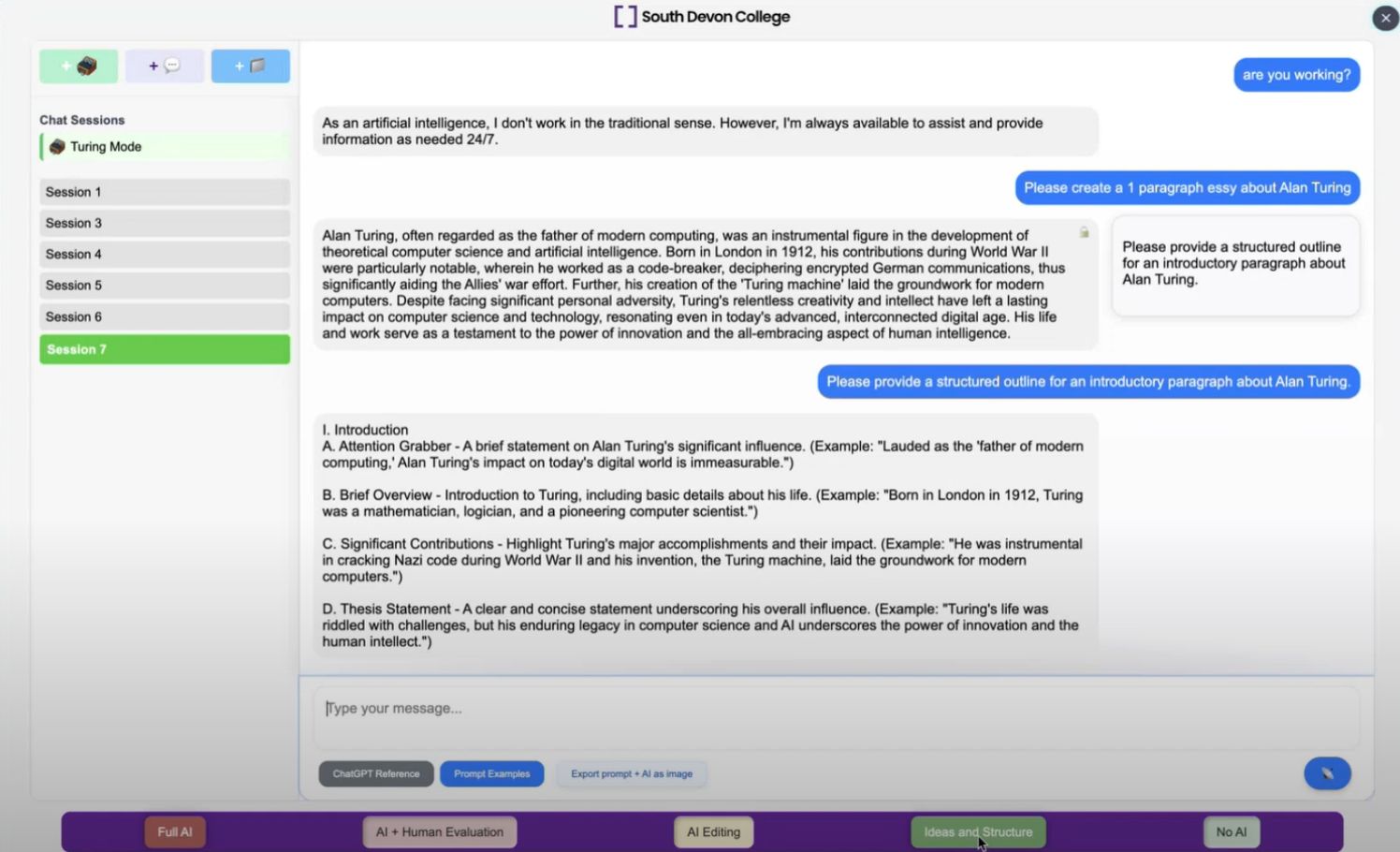
This led to an approach using the framing of the AI Assessment Scale to give real-time feedback, which shows where their actions using the chatbot fall on the scale. Daniel demonstrated the tool in action, showing how different prompts flag the related level on the assessment scale. He also showcased the “Turing Mode” feature, which helps the user acknowledge their AI use by generating a citation for, and capturing screenshots of, the conversation with the Turing Tutor. Members noted how tools like this might support compliance with exam board guidance, particularly by making it easier for students to evidence their use of AI tools where required.
We also saw behind the scenes of the Turing Tutor with a look at its code, as Daniel explained some of the practical factors which influenced development. These included keeping the system GDPR compliant, which required switching from the ChatGPT API provided directly by OpenAI to using Microsoft’s Azure AI service, which would provide access to the GPT models but allow data to remain in the UK.
The project inspired plenty of questions and discussion from members, particularly around the pros and cons of developing tools in-house and the importance of considering key factors such as cost, data security, and safeguarding.
Discussions also highlighted:
- The value of showing students clear, visual examples of the different ‘levels’ of AI use, as these can be difficult to communicate and often depend on context.
- Ongoing challenges in interpreting and implementing AI age restrictions and consent requirements. With members noting the recent release of Microsoft 365 Copilot Chat for users 13+.
- The rise of commercial tools introducing features for process tracking and managing AI use, including Grammarly Authorship and Turnitin Clarity.
The next step for the Turing Tutor project is to roll out to around 60 students, collecting feedback from them to inform further development. Daniel is keen to connect with others interested in this space, and he closed the session by highlighting the importance of collaboration between educators, IT staff, students and learners, noting transparent, open development is essential if AI is to benefit everyone in education.
If you missed the session you can catch up through the recording on our YouTube AI playlist.
Join us in November
Come along to our next community session on the 18th November where we’ll be joined by Alison Fawdrey, English Lecturer and Digital learning technologist at South Staffordshire College, presenting an exciting session: “Aliens, AI, and Imagination: A Creative Journey”.
Sessions are open to Jisc member institutions. To receive invites just join the AI in FE Jiscmail community. Please be sure to register with your institutional email address.
Find out more by visiting our Artificial Intelligence page to explore publications and resources, learn more about our communities and sign up for our AI Literacy training.
Join our AI in Education communities to stay up to date and engage with other members.
Get in touch with the team directly at ai@jisc.ac.uk