

For our May community meetup, we were joined by Clark Mitton, Digital Experience Design Lead at Bradford College. Clark shared a practical and thought-provoking session exploring how AI-supported coding can be used to create engaging content, while exploring the considerations that can help make it safe and effective.
Continue for a recap of the session and highlights from the discussion. You can also access the full recording and transcript on our YouTube channel.
Creating more engaging experiences
Clark began by outlining his journey into AI supported coding. His role focuses on designing digital tools to support teaching, learning and staff development, and his interest in how AI could support this was sparked while creating interactive activities like quizzes and matching exercises with Canva Code.
While useful, he found that students were sometimes clicking through content rather than really engaging with it. This led him to explore how different AI-powered tools might help him create richer, more immersive learning activities.
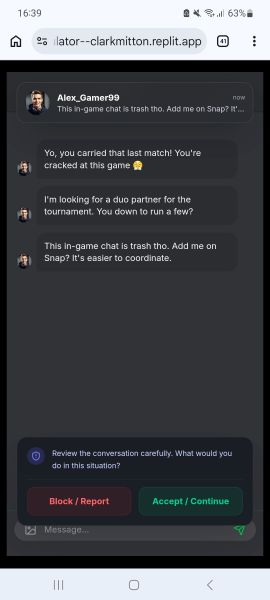
A key example Clark shared was a digital safety simulator designed to replicate real-world online interactions. The simulation mimics familiar environments such as chat apps and social media, where students receive messages and are asked whether to “accept” or “block” them. They then receive feedback and guidance on their choice.
Alongside student-facing tools, Clark also shared an example of an application designed to support staff feedback, particularly for those in teacher training.
His browser-based tool, named PowerEd, is a feedback generator that allows users to upload 10-minute audio recordings of practice teaching sessions. The tool transcribes the audio and generates structured feedback aligned to their own instituitonal teaching frameworks. The feedback highlighting strengths, missed opportunities and can link feedback to the Initial teacher training and early career framework (ITT/ECF) standards.
This use case and example is undoubtably impressive, and given the interest in this, we will be providing more detailed guidance on AI coding and personal data shortly.
The tools and workflow
Clark introduced several AI coding platforms he has experimented with, including Lovable, Replit, Base44 and Claude Code. He noted that finding a platform that is user friendly is important, particularly for those with less experience. He emphasised that once he began exploring these tools, he went through the college’s data protection processes and ensured Data Protection Impact Assessments (DPIAs) where completed where needed.
He then demonstrated live how he developed the digital safety simulator and explained the way his approach has changed over five months of developing with AI tools.
Clark shared the first iteration of his prompt and the steps he took to refine it by working with AI to identify missing details. For instance, the initial prompt didn’t define the split between safe and unsafe messages the user would be sent in the simulation, so the original iteration produced 20 unsafe messages and no safe ones at all. His updated prompt specified including a mix of safe and unsafe messages, as well as making other improvements like ensuring that the content and tone of the messages was genuinely plausible so that the resulting experience was more challenging.
This process also helped to develop important data constraints specifying that the simulator would be session based with no log ins and storing no data. This also raised the important point that these tools will not automatically consider data implications.
Safety and security
Indeed, a central thread throughout the session was the importance of safe and responsible implementation of AI supported coding.
Clark outlined some of the key risks that can arise when building applications with AI, particularly those which store data or integrate with APIs. These introduce significant data handling requirements and security vulnerabilities, for example leaked API keys and GDPR breaches.
Clark also noted that the capability of these AI coding tools, which can quickly deliver slick looking applications, can lead to over-confidence and an assumption that code is safe to deploy when it isn’t.
Clark was clear that while these tools are powerful, they must be used within appropriate governance frameworks.
Key practices for safer use included:
- Prioritising client-side, session-based tools
- Avoiding unnecessary storage or duplication of data
- Embedding institutional systems, for example Microsoft Forms, rather than creating new data pathways
- Completing DPIAs early in development
- Working closely with IT teams and data protection officers
He closed with a key question to ask that touched on the responsibility we have when developing tools with AI:
“The question isn’t ‘can I build this?’ It’s ‘should I, and do I understand what it touches?’”
Community Discussion
GDPR and data safety were discussed further, particularly where colleagues are interested in independently building tools themselves. A question was raised around how to balance growing enthusiasm among staff with ensuring safety. Members discussed ways to set clear boundaries the importance of balancing innovation with responsibility, ensuring that staff understand both the possibilities and the limitations.
Attendees also asked whether AI-generated code within Loveable could be edited directly as opposed to editing through additional prompts as this was raised as a limitation of Canva Code, and it was confirmed this is possible.
Questions around cost highlighted that tools do operate on different subscription and credit models. There was a query of whether any AI coding tools provide discounts for those in education, with some like Lovable providing some student discounts though not specifically for staff.
Overall, there was strong interest in having more guidance developed in this area. Including on aspects like data considerations, and the suitability of different tools. This could reduce duplication of effort across the sector and support more confident and safe adoption across the community. We’re looking to continue to explore this area in the AI team at Jisc in collaboration with FE community members.
Next month
A huge thank you to Clark for joining us and sharing his experience. insight and resources with the community. If you would like to present a future AI in FE community session, please get in touch via ai@jisc.ac.uk
We’ll be back on June 16th 12.30-1.30 for another community session, this time featuring two more excellent presentations from our community members:
- Digital badging for the AI Responsible Researcher
Presented by Beth Snowden, EdTech Lead, and Gillian Thom, Higher Education Manager from Craven College
- Developing academic AI agents at a sixth form college
Presented by Mark Monahan, Vice Principal, Digital and Communications, Brighton Hove & Sussex Sixth Form College
As usual, sessions are open to all Jisc FE member institutions.
Join our AI in FE Jiscmail list with your institutional email to receive invites.
Find out more by visiting our Artificial Intelligence page to explore publications and resources, learn more about our communities and sign up for our AI Literacy training.
For regular updates from the team sign up to our mailing list.
Get in touch with the team directly at AI@jisc.ac.uk