
AI sign language translation is emerging as a fast-moving and important area of interest in the sector. This interest is no longer theoretical, over the past year we have now seen AI sign translation services being publicly utilised in the UK. With this we’ve also noticed growing numbers of members asking whether such tools are ready for use in education.
Recently, we were also fortunate to support a session on ‘AI and accessibility skills’, part of the Teaching Accessibility in the Digital Skill Set project led by Dr Sarah Lewthwaite (University of Southampton) and supported by Jisc. The session included an excellent presentation from Tim Scannell, British Sign Language (BSL) teacher and accessibility consultant, who explored the key challenges and opportunities in AI sign translation and shared perspectives from the Deaf community on the technology.
This combination of member interest and expert insight prompted us to look more closely at the current landscape of AI sign translation. In this blog, we bring together a range of examples of projects and products, look at their different approaches, and consider whether the technology is ready for use in the sector.
Considering the Context
Before we get to the tools, it’s important to understand the context they’re being developed in. The creation of AI models for sign language translation is different to that of spoken languages, not only because sign languages are visual languages, but also because of the social and historical contexts involved.
Sign languages are complex, with their own syntax, grammar and regional variations. In BSL, differences can appear even between neighbouring areas as dialects have developed locally. Unlike many spoken languages, there isn’t a large supply of sign language data available in textbooks or on the internet to collect for model training. Much of that knowledge lives within the Deaf community, with sign language users and is a key part of Deaf culture.
Historically, that culture has been actively suppressed, and the teaching of sign languages was discouraged and even banned across Europe well into the late 20th century. In the UK, BSL was only officially recognised as a language in its own right in 2003, and in 2022, after much campaigning, the British Sign Language Act recognised it as an official language of England, Wales and Scotland, requiring that provisions be in place to promote its use. Notably, the Scottish parliament did pass their BSL Act in 2015, so this was a requirement in Scotland earlier. Similar milestones are still being reached across the globe, with campaigners succeeding to finally have Japanese Sign Language officially recognised by their government in July this year.
Controversial development
We would expect a project aiming to produce AI translation of a spoken language to be led by a native speaker of that language, or at least speakers with considerable experience and high competency in speaking it, as well as an understanding of the historical and cultural contexts that have shaped that language.
Unfortunately, this hasn’t been the case for many AI sign language translation projects. These now controversial examples had neglected to meaningfully involve Deaf sign language users in their development, and approached sign translation more as a technical issue to be solved rather than a way to improve accessibility of communication.
A key instance has been projects developing sign language gloves, wearable technology that involves the signer wearing gloves fitted with sensors which track hand movement, interpret the related sign and convert that into text. Critically, this approach reduces sign language to a set of hand shapes that mimic spoken words, rather than unique languages that incorporate nonmanual movements like facial expression and have their own grammatical structure. These gloves also do little to address the actual accessibility barriers Deaf people face, instead centring the hearing person’s convenience in understanding sign language.
These approaches have garnered significant media attention and praise in the past despite criticism from the Deaf community and pieces like the Atlantic’s ‘Why Sign-Language Gloves Don’t Help Deaf People’. Critics point to a lack of transparency about whether Deaf individuals or communities were involved in these projects at all. The attention and in some cases, funding put into such ventures has been seen as unearned and potentially as a distractor, also from Deaf-led initiatives that could have had a real impact.
With this context in mind, we can see why the design of AI tools for sign language translation should not be treated as a purely technical challenge. The products and projects we look at in the next section sit within this wider landscape, which is shaped by the cultural significance of sign languages, the lived experiences of Deaf people, and the need for approaches that respect both.
Products and Projects
Signapse AI
Signapse appears to be one of the most developed platforms currently offering AI translation for BSL. Their AI translation service, SignStream, handles both text-to-sign and sign-to-text, using a photorealistic AI-generated signer. It’s worth noting that they’re not solely an AI translation company, they foremostly provide human translation services and also support American Sign Language (ASL). Their website emphasises a commitment to inclusivity and promoting Deaf leadership, with Deaf staff working across development and translation roles and holding leadership positions in the company.
At a recent Signapse webinar, we felt their team were transparent about the current capabilities of their AI translation. They explained that they use a measure of “understandability” when testing their AI translations rather than looking for grammatical accuracy, as they feel this is more suitable considering the variation in how sign language is used and understood by different users. They use an internal tier system for appraising their model, as of June 2025 they rate their current system at tier 2, which they describe as foundational but they have plans to reach tier 5 (advanced) in December.
For now, they recommend the service for shorter, one-way communications such as public announcements and digital signage. Development priorities included improving that understandability rating, focusing the model on using BSL grammar rather than English, expanding its vocabulary of signs, and enhancing the generated signer with nonmanual features like facial expressions and more body movement.
They recently explored its use for announcement style communications in a 2024 partnership with Whoosh Media, South Western Railway (SWR), and Network Rail. Launching a service accessed via QR codes, which provided AI BSL translations of real-time rail information such as departures, arrivals, and platform numbers to make rail travel more accessible. That we could find, they haven’t yet shared feedback on the effectiveness of the project or responses to the app from sign language users.
For customers, Signapse currently offers a beta of SignStream within their SignStudio video translation service. Crucially, this includes human review of the generated video by multiple native BSL users. They’ve also made a demo of SignStream available for free on their website, where anyone can translate up to 20 words at a time for free.
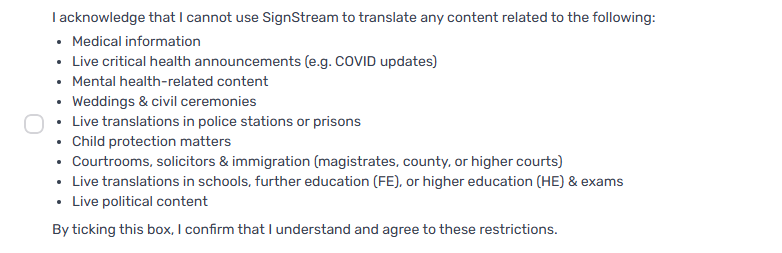
The speed at which translations are generated with SignStream is impressive, with most taking under 40 seconds. They are clear though that these generated outputs are not human reviewed, and therefore not suitable for many use cases. They include specifically “Live translations in schools, further education (FE), Higher Education (HE) & exams” in their acknowledgements section, and users need to confirm that they understand this before accessing the tool.
Silence Speaks
Silence Speaks is a UK based startup founded in 2021, they are backed by funding from Innovate UK (UKRI) and have just recently launched their own website this year. They have Deaf team members in both their development team and in leadership roles, and their board is chaired by the Rt Hon Chloe Rebecca Smith, who is a Special Ambassador for the British Deaf Association and led on the 2022 legislation recognising BSL in UK law. Their AI service translates text, voice and video into sign videos.
According to WIRED, their current focus is on support for both BSL and ASL translation and improving the latency of those translations. They don’t yet have a live demo available, but their website hosts some video examples. They also note plans to expand into International Sign and more regional sign languages next year, with the online demo showing Polish, Indian, and Irish sign language options. As well, they suggest further potential use cases across a wide variety of sectors, including retail, healthcare, banking and education, with suggestions for the latter including translation of course materials and assessments.
Uniquely, they look to offer a choice of the design of the AI signer, with the user selecting from cartoonish to photorealistic styles. This is an interesting approach, as we noted that some of the other services have chosen to focus solely on photorealistic signers. Though the offer of choice is interesting, realistic styles may be considered to more closely mirror people’s experience of human interpreters and be more suited to conveying nonmanual aspects of sign languages, such as facial expression and body position. As these are visual languages, the appearance of the digital signer plays a significant role.
Similarly to Signapse, they are applying their service to improve accessibility in the transport sector, with a partnership with Transport for London. This will see their AI signer added to digital displays, and QR codes will provide passengers access to AI sign language translations of live transport information.
At present, their online presence shows they have a lot of ambition in what they are hoping to deliver. There are limited details on the current scope of their service, though, and we will be interested to see outcomes from their upcoming partnership.
Sign-Speak
Sign-Speak is a Deaf-led company based in the US providing AI American Sign Language (ASL) translation tools. While they don’t currently support BSL translation, we think their approach is worth noting for comparison.
Sign-Speak’s service is unique in that they can readily translate between sign, text and audio, which means they can offer an automated interpreting service. According to their website, this can interpret live conversations using a generated photorealistic signer. This service can be added to virtual meetings or used on a device via a QR code for in-person meetings. They also have SignLive, a tool for live captioning with the digital signer translating in real time in the corner of the screen, and CaptionASL, which provides English subtitles for ASL videos.
Sign-Speak say that their AI translation software achieves a Bilingual Evaluation Understudy (BLEU) score similar to that of the average human interpreter (60 or 0.6). BLEU is a widely used benchmark for machine translation, which measures similarity between generated and human translations of the same piece. This can indicate the quality of the translation, but may not necessarily reflect how natural or easy to understand that translation might be.
Google’s SignGemma
There has been some involvement of the larger tech companies in this space. In May, Google announced SignGemma, a model for translating sign to text or synthesised speech. Though the announcement gained attention there hasn’t been a lot of detail yet about SignGemma.
What we do know is that SignGemma is focused on ASL translation, though Google state that as a foundation model it could be developed to translate other sign languages. This would presumably be dependent on whether there is sufficient, quality data available of other sign languages for that development though.
At this time they have shared little about how the model was created, how they have involved Deaf people in development, or how accurate and understandable its translations are. A preview version was released on Google’s AI Developer platform shortly after the announcement, along with a feedback form, but that has since closed.
As part of the open-model Gemma family, Google says SignGemma will be available to build upon later this year. We hope the lack of transparency and detail is rectified before the release to allow for evaluation of both the technology and how the Deaf community has been included within its development.
SignGPT
Lastly, SignGPT is an ambitious five-year research project to create a sign language Large Language Model (LLM). While LLMs based on spoken and written language have enhanced communication opportunities for many, these advances have often not been accessible to the Deaf community. The SignGPT project looks to change that.
To train their sign language LLM the project aims to first build the world’s largest sign language dataset. They intend that the trained model will provide the same level of application for sign languages that current LLMs are offering for spoken and written languages. Other outputs also include open-source toolkits and tools for data annotation that will be made available to the wider research community.
The project has received £8.45m in funding from the UK Engineering & Physical Sciences Research Council and is a collaboration of researchers from the University of Surrey, the Deafness Cognition and Language Research Centre at University College London, the University of Oxford and the Deaf community.
Quotes from the project team in their January press release emphasise the focus on co-creation in this project with the Deaf community, employing Deaf staff, and taking an ethical approach to model development. They have been actively recruiting more project staff for whom BSL is their primary language.
Is AI BSL ready for education in the UK?
At this time, the tools we’ve found for BSL translation look to be most suitable for short, announcement style messaging. There perhaps aren’t many applications in education that we might look to use this. Further, there remain significant concerns around the quality of translation that an AI-generated signer can deliver. The risks these issues pose outweigh the potential benefits of the technology, which still requires considerable development.
Currently, early implementations in public services look to be focused on improving accessibility of important information, which is positive. However, we are lacking detail on the outcomes of these projects and feedback from BSL users. We can see that companies like Signapse are actively addressing limitations of the technology, and will be keen to see if they do reach a point where those risks are substantially lowered.
We can perhaps see the future potential of tools for BSL in the offerings of services like Sign-Speak and their automated interpreting service for ASL. AI sign interpretation poses further challenges and concerns though, with real-time AI interpretation leaving less room for human oversight and corrections.
Though the pace of AI sign language translation may be slower than that of many spoken languages, it is essential that it is not rushed. It is vital that data is sourced responsibly, and implementations are carefully considered. SignGPT, presents a longer-term, ethical approach to creating a rich resource for sign language AI that serves the Deaf community’s needs. Other projects, like Google’s SignGemma, may arrive sooner, but for now, there is little information about how they have been developed or whether they will be useful for BSL translation.
Calls for regulation
We’ve focused on providing some context in relation to the development of these tools and considered what the technology may be capable of right now, with the idea of questioning whether it is ready for use in education. But there are much broader implications around the use of such tools, how they could impact the Deaf community and even affect the evolution of BSL as a language.
There are significant calls for regulation to address these risks now, before this technology is more widely implemented. This year, the British Deaf Association released a discussion paper, ‘Artificial Intelligence, British Sign Language and the British Deaf Association’, which highlights key interests and concerns around AI BSL. The paper advocates for a framework to set standards for AI BSL development that safeguard both the language and its users.
A recent series of publications from the European Union of the Deaf (EUD) provides a framework for safeguarding the rights of deaf signers in the wake of AI development. Including a template contract if they are approached by AI developers looking to record them for training data. As well as a set of 15 principles to guide any AI project involving sign languages, addressing areas such as cultural respect, inclusive design, and human-rights-centred deployment.
Meanwhile, recommendations in a recent report from the Minderoo Centre for Technology and Democracy, “BSL is Not for Sale: A Deaf-led approach to AI procurement”, respond to concerns over the procurement of AI BSL by public services in the UK. Highlighting risks extending from harm to public trust in those services, to the legal consequences of not meeting their obligations under the BSL Act and the Equality Act. The report underscores the critical need for Deaf-led leadership and governance in the development of AI BSL.
Overall, we see that this is a space to watch and to approach thoughtfully. It’s important that we understand how these tools are built, who has been involved in their development, and what they are realistically capable of in order to be discerning when applying them. Even as these tools improve, they are not replacements for human interpreters or an excuse for hearing people not to learn sign languages. Developed and used well, they could become powerful ways to improve accessibility and create new avenues for communication. For this to be achieved though, Deaf sign language users must be centred at every stage – from development through procurement to implementation.
Find out more by visiting our Artificial Intelligence page to explore publications and resources, learn more about our communities and sign up for our AI Literacy training.
Join our AI in Education communities to stay up to date and engage with other members.
Get in touch with the team directly at ai@jisc.ac.uk